
ブログ投稿――CAR-T療法および臨床試験におけるフローサイトメトリーの役割

作成日:2025年6月4日

おかえりなさい!flow cytometry前回の投稿では、フローサイトメトリーとは何かに関する重要な背景や、臨床試験の場での最適な活用方法に関する一般的な視点について紹介しました。この記事では、フローサイトメトリーが大きな影響を与える特定の臨床応用に焦点を当てます。免疫療法、特にCAR-Tのような細胞内療法です。


CAR-T療法入門:

CAR-T(チメリック抗原受容体T細胞)療法は、特にB細胞リンパ腫や急性リンパ性白血病(ALL)などの血液がんに対して、がんとの闘いにおいて主要な役割を果たしている。この最先端の治療法では、患者のT細胞を改変し、がん細胞をより適切に識別して攻撃できるようにする(Ref.1,2)。CAR-T療法には2つのタイプがあります:
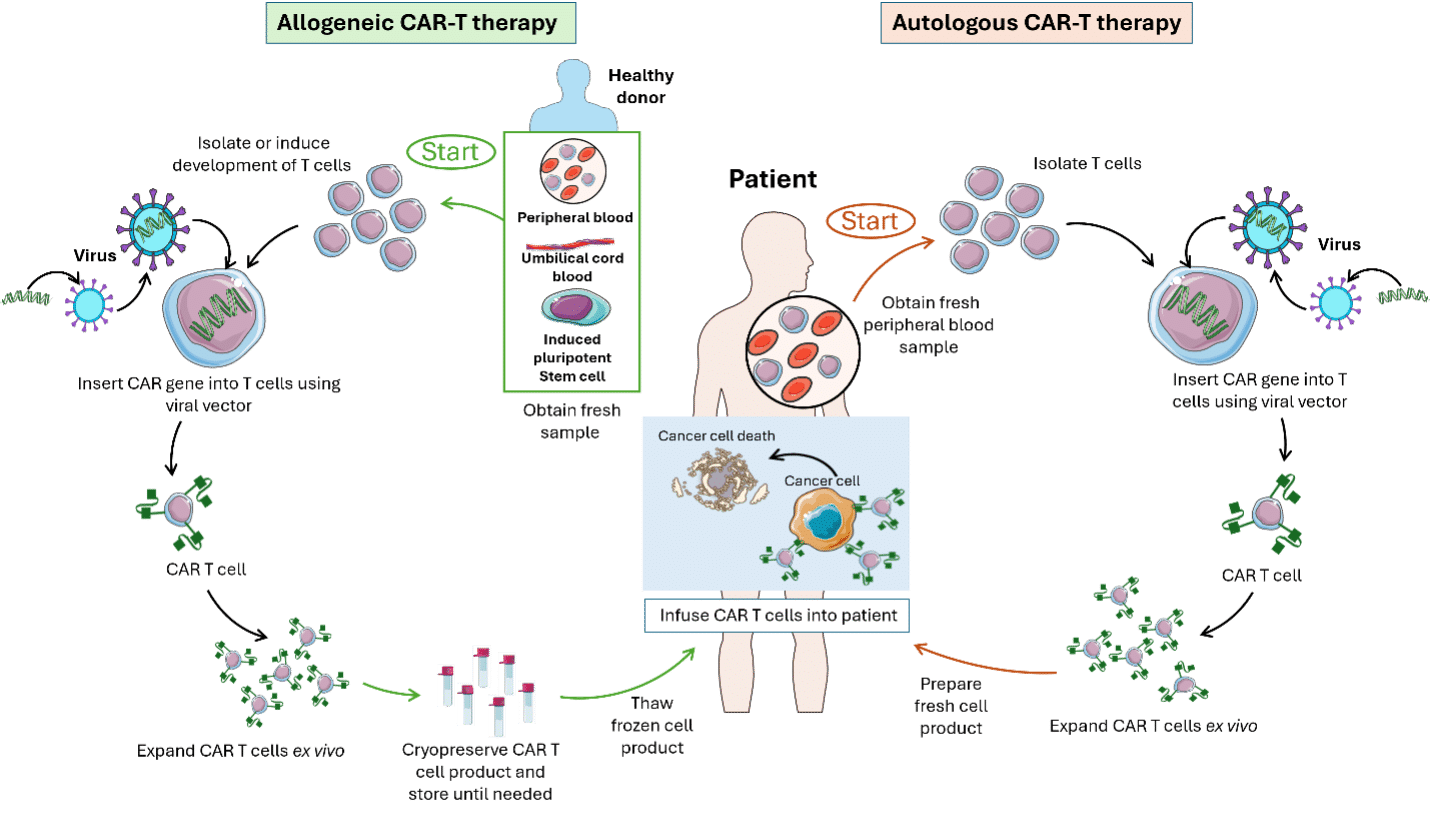
  • Autologous CAR-T therapy自己接着性CAR-T療法:患者自身のT細胞を使用する。このアプローチにより免疫拒絶反応のリスクが低減されるが、CAR-T細胞の調製にはより長い時間がかかり、患者にとって費用がかかる可能性がある。
  • Allogeneic CAR-T therapyアロゲネイクCAR-T療法:健康なドナーT細胞を「市販」の選択肢として使用できるため、CAR-T細胞は直ちに患者を治療できます。これらの細胞はドナー由来であるため、拒絶反応のリスクが高く、持続性が低いことが示されている

svg%3E

図1:自家用語の制作手順 vs.Orange arrowsアレルギー性CAR-T細胞療法:オレンジ色の矢印は、自己接着型CAR-T(患者由来T細胞)に特有の手順を示しています。Green arrows緑色の矢印は、アロジェネイックCAR-T(健康なドナー由来T細胞)に特有の手順を示しています。Black arrowsshared steps黒い矢印は、2つの治療法の間に共通するステップを示している。


フローサイトメトリーがCAR-T療法において重要な役割を果たす方法:

CAR-T細胞自体が注目されているが、フローサイトメトリーは、改変されたT細胞の製造から安全性の確保、治療の成功の追跡に至るまで、CAR-Tプロセス全体にわたって頻繁に登場する。フローサイトメトリーアッセイは、個々の細胞挙動を評価し、CAR-T治療が各患者にとって有効かつ安全であることを保証するための最適なアプローチです(参考。3)。ショーのバックステージクルーと同様に、フローサイトメトリーはすべてがスムーズに動作するようにします。

以下は、CAR-T研究のさまざまな段階でフローサイトメトリーが果たすことができる多くの役割のいくつかです。
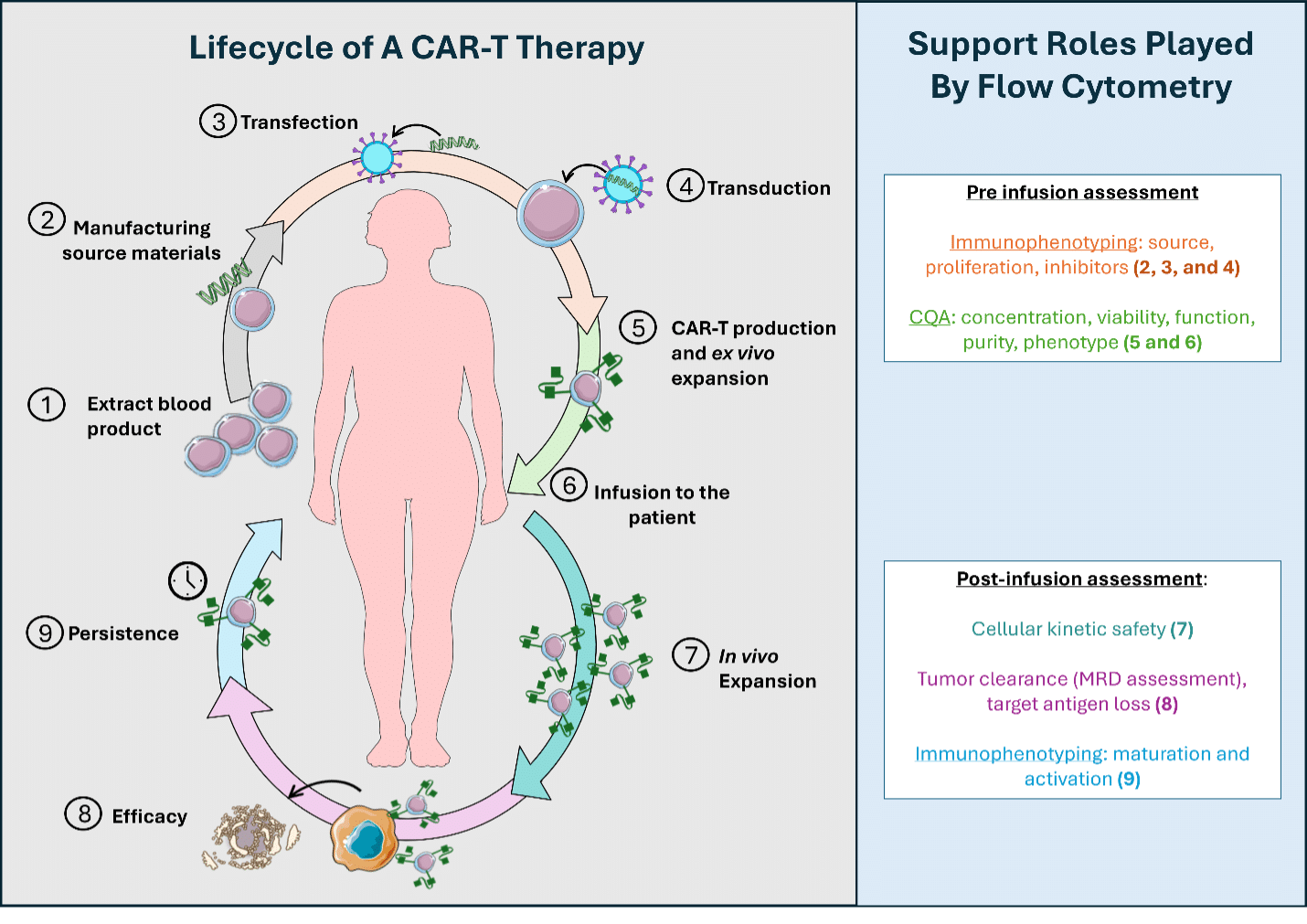
  1. CAR-T細胞製造プロセス
    • Transduction Efficiencyトランスダクション効率:T細胞がCARを発現するように改変された後、フローサイトメトリーを使用して、その変化がどの程度うまく機能したかを確認できます。このチェックは通常、T細胞にCARに特異的に結合する蛍光抗体をタグ付けし、フローサイトメトリーを使用して、成功した細胞の数を測定することで行われます。
    • Phenotypic Characterizationフェノティピック特性評価:数字だけの問題ではない。フローサイトメトリーは、CAR-T細胞が患者の体内で体内に残留して働き続ける可能性があるかどうかを示す表面マーカーなど、CAR-T細胞が適切な特性を持つようにするためにも使用できます。
  2. 品質管理およびリリーステスト
    • Purity and Viability純度と生存率:フローサイトメトリーは、注入前のいくつかの重要な質問に答えるのに役立ちます。CAR-T細胞は純粋で生存可能ですか?細胞は戦う準備ができているのか(つまり、活性化のバイオマーカーを発現する)の準備ができているのか?
    • Functional Assays機能的アッセイ:フローサイトメトリーは、CAR-T細胞が本来あるべきことを確実にし、がん細胞を潰すために用いられる。細胞毒性検査を実施することで、フローサイトメトリーはCAR-T細胞ががん細胞を殺す上でどの程度効果的であるかを定量化できる。
    • Safety Testing安全性試験:フローサイトメトリーは、有害な結果を引き起こす可能性のある不要な細胞を検出するのに役立ち、治療が患者にとって安全であることを保証します。
  3. 臨床試験におけるCAR-T療法のモニタリング
    • Post-Infusion Monitoring輸液後モニタリング:CAR-T細胞を注入した後も、フローサイトメトリーは血液中のそれらの挙動をモニタリングするための強力なツールであり続けています。拡大、持続性、表現型を追跡し、治療効果がどのくらい続くか、およびサイトカイン放出症候群(CRS)などの有害事象が進行しているかどうかを臨床医が理解するのを助けます。
    • Biomarker Discovery and Immune Profiling: Flow cytometry is also used to profile the patient’s immune response to the CAR-T therapy, helping researchers discover biomarkers that could predict how well a patient will respond or whether they might develop resistance.
    • Assessing Minimal Residual Disease (MRD): In blood cancers, flow cytometry can assess MRD, providing a clear picture of how well the CAR-T therapy has eliminated cancer cells. This information is crucial for deciding if more treatments are needed.

svg%3E

Figure 2: Flow Cytometry Assessment of CAR-T Cell Therapy Before and After Infusion. Flow cytometry enables evaluation of CAR-T cell therapy at various stages, both before and after infusion. This figure highlights the key assessment points throughout the CAR-T process using flow cytometry.

At HBRI, we make full use of the power of advanced flow cytometry assays to monitor CAR-T Therapy in clinical trials. Our real-time monitoring tracks how CAR-T cells expand, persist, and interact with the immune system, helping to spot any issues early and fine-tune treatments for safer, more effective results.

Success Stories in CAR-T Therapy

Several CAR-T therapies have been approved by the FDA, including well-known names like Kymriah, Yescarta, Tecartus, Abecma, Breyanzi, and Carvykti (Ref.4,5).

Let’s dive deeper into Carvykti (ciltacabtagene autoleucel), one of the newer FDA-approved CAR-T therapies, and how flow cytometry played a key role in its development. Approved in 2022 for relapsed or refractory multiple myeloma, Carvykti targets BCMA (B-cell maturation antigen) on cancerous plasma cells.

Flow cytometry was crucial during the clinical trials of Carvykti for several reasons:

  • Assessing Transduction Efficiency: In the early stages of manufacturing, flow cytometry was used to confirm that the T cells were successfully engineered to express the CAR that targets BCMA. This step ensured that the therapy would be effective in recognizing and attacking the cancer cells.
  • Monitoring CAR-T Cells in Real Time: During the clinical trial, flow cytometry allowed researchers to track how well the CAR-T cells expanded in the patient’s body after infusion. It gave real-time insights into how the cells were behaving, helping clinicians understand how long the CAR-T cells were sticking around and how effectively they were eliminating the cancer.
  • Evaluating MRD and Patient Outcomes: Flow cytometry was also used to assess whether any cancer cells remained in the patients after treatment, known as minimal residual disease (MRD). This helped researchers and doctors determine how effective the therapy was and make decisions about additional treatments.

Overall, flow cytometry was instrumental in showing that Carvykti could induce deep and lasting responses in patients with advanced multiple myeloma, making it a powerful addition to the CAR-T therapy landscape.


Conclusion

Flow cytometry is the unsung hero behind the success of CAR-T therapies, providing critical data at every step—from ensuring the CAR-T cells are engineered correctly to monitoring their behavior in clinical trials. With its ability to provide real-time insights, flow cytometry continues to play a key role in making these therapies safer and more effective for patients.

If you’re working in CAR-T research or clinical trials, flow cytometry should be in your toolkit; it certainly is in ours!


References

  1. Wei, J., Guo, Y., Wang, Y., Wu, Y., Qin, Y., and Ye, Y. (2021). Advances in CAR-T Cell Therapy for Cancer: Factors Affecting Therapeutic Efficacy and Resistance Mechanisms. Frontiers in Immunology, 12:658314. https://www.frontiersin.org/journals/immunology/articles/10.3389/fimmu.2021.658314/full.
  2. Nature Portfolio. (2023). The Next Generation of Cancer Treatments: CAR-T Therapy. https://www.nature.com/articles/d42473-023-00226-1
  3. HBRI. E-book: Flow Cytometry and CAR-T Cell Therapy. https://cerbaresearch.com/white-papers/e-book-flow-cytometry-car-t/.
  4. Hillman Cancer Centre. FDA-Approved CAR-T Cell Therapies. https://hillman.upmc.com/mario-lemieux-center/treatment/car-t-cell-therapy/fda-approved-therapies.
  5. U.S. Food and Drug Administration (FDA). https://www.fda.gov/.

Illustrations created by Sanaz Koosha using Servier Medical Art by Servier, licensed under CC BY 4.0 (https://creativecommons.org/licenses/by/4.0/).

About the Author

Sanaz Koosha

Sanaz is a Scientist on the Flow Cytometry team at HBRI, based in New York. She joined HBRI in 2023 after completing a postdoctoral fellowship at the Perelman School of Medicine, University of Pennsylvania. She holds a PhD in Biotechnology from the University of Malaya. Her expertise spans flow cytometry, CAR T-cell therapy development, tumor microenvironment studies, and cancer drug discovery.